


Share This Article
Cem Tuna Aksu
As of 2026, the geopolitics of the Middle East are undergoing one of the most profound and disruptive transformations of the post-Cold War era. The spiral of conflict, originating in Gaza and cascading across Lebanon, Syria, Iraq, Yemen, and directly into Iranian territory, has laid bare the limits of the traditional international order and the waning capacity of Western powers to guarantee regional stability. As the United States progressively pivots its strategic focus toward the Indo-Pacific while taking a more selective stance in global crises, regional actors are compelled to diversify their security dependencies.
Concurrently, Israel’s aggressive and pre-emptive military posture—backed by US support and cutting-edge defense technology along an arc from the Eastern Mediterranean to the Gulf—has dismantled long-standing regional balances. Iran has suffered the most severe strategic setback in this realignment. Tehran’s long-cultivated ‘Axis of Resistance’ and its reliance on proxy-driven asymmetric deterrence have been critically eroded. This strategic vulnerability was underscored by Iranian Foreign Minister Abbas Araghchi, who noted that the nation must now “rely solely on ourselves and embrace true brotherhood”. To counter its growing isolation, Tehran is expected to employ divide-and-rule diplomacy targeting the emerging trilateral alignment of Türkiye, Pakistan, and Saudi Arabia, while leveraging Houthi and regional militia networks to exert asymmetric pressure.
This expanding security vacuum is simultaneously reshaping key global trade and energy corridors. A counter-coalition comprising India, Israel, the Republic of Cyprus, and Greece is seeking to forge an alternative commercial and strategic transit route connecting the Eastern Mediterranean to the Indian Ocean. Designed in part to offset the growing weight of the Türkiye–Saudi–Pakistan axis, this project illustrates how geoeconomic routes are becoming the primary infrastructure of contemporary military and political alliances. A parallel friction is visible within the Gulf Cooperation Council: while Saudi Arabia anchors its defense strategy alongside Türkiye and Pakistan, the United Arab Emirates (UAE) views this concentration of influence with caution, opting instead for a flexible hedging strategy by deepening bilateral security ties with India and Israel. Qatar, meanwhile, remains firmly aligned with Ankara, preserving its historic defense and political partnership.
ARCHITECTURES OF DETERRENCE: THE MECCA AGREEMENT AND THE RISE OF MINILATERALISM
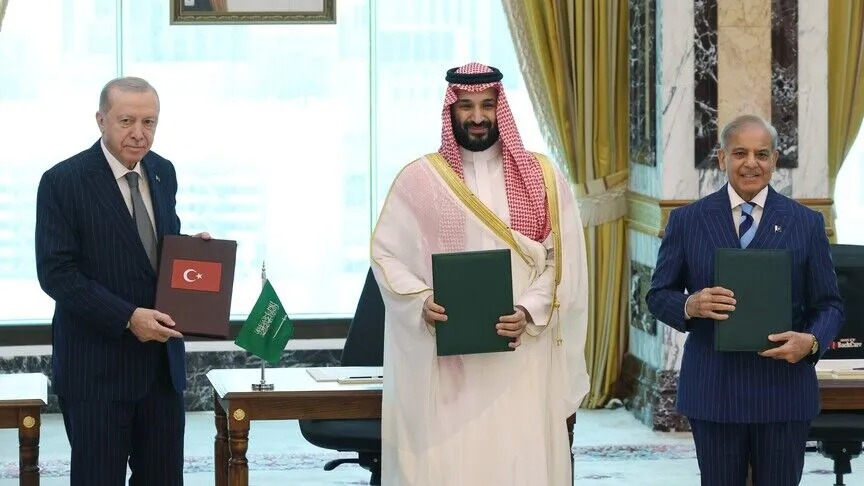
Amid shifting corridor politics and regional volatility, the signing of the Mecca Joint Defence Agreement on August 7, 2026, by Turkish President Recep Tayyip Erdoğan, Saudi Crown Prince Mohammed bin Salman, and Pakistani Prime Minister Shehbaz Sharif represents a watershed moment in Middle Eastern alignment. Culminating over two and a half years of diplomatic orchestration led by Foreign Minister Hakan Fidan, the pact anchors its collective defense commitments in Article 51 of the UN Charter, establishing that an armed attack against any single signatory will be treated as an attack against all. The arrangement synthesizes complementary strengths: Türkiye’s advanced defense industrial ecosystem, operational capability, and NATO interoperability; Pakistan’s nuclear capability, massive standing army, and missile technology; and Saudi Arabia’s financial capital, energy market dominance, and diplomatic reach. Institutionalized through a Saudi-based Secretariat alongside Joint Political and Military Committees, the framework possesses the potential—particularly if joined by regional partners like Egypt—to anchor a broader security perimeter encompassing the Red Sea, the Suez Canal, and the Eastern Mediterranean.
Fidan’s characterization of the pact as “technically identical to NATO’s Article 5” has prompted rigorous debate within Turkish strategic circles. Foreign policy analysts, including journalist Murat Yetkin, have raised critical operational questions regarding Türkiye’s automatic entanglement in potential contingencies—such as a direct Iranian assault on Saudi territory, escalation between India and Pakistan, or lingering Houthi strikes in Yemen—and how such commitments align with Ankara’s NATO obligations. Turkish officials have clarified that the mechanism does not trigger automatic military action; assistance remains contingent upon formal request, situational assessment, and unanimous consensus among member states.
Ultimately, the Mecca Agreement marks the clearest realization yet of Türkiye’s strategic hedging and minilateralist foreign policy, moving away from single-power dependency toward agile, multi-vector partnerships. Whether this pact remains a high-level statement of political solidarity or matures into an integrated security architecture through systematic intelligence sharing, defense industrial co-development, and institutional cohesion will be tested by future regional crises. In an environment defined by Israeli military expansionism and broader global uncertainty, Ankara’s leadership in this coalition positions Türkiye as a decisive architect in the emerging Middle Eastern balance of power.
References
Anadolu Agency. (2026, August 7). Turkey, Saudi Arabia and Pakistan sign Joint Defence Agreement. Anadolu Agency.
Ceylan, M. F. (2026, August 10). Evolution of the concept of deterrence: New foundations of deterrence. Ankara Policy Center.
Özerdem, A. (2026, August 10). The Mecca Agreement: From a new alliance to a regional security order? Yetkin Report.
Yeşiltaş, M. (2026, August 8). Mecca Joint Defence Agreement: Political solidarity or military alliance? AA Analysis.
Yetkin, M. (2026, August 9). Issues requiring clarification by the government regarding the Mecca Agreement. Yetkin Report.